
DeWitt County Projected Versus Actual Release
TDCJ defines Projected Release Date as the agency's calculation of the date a person is expected to be released if nothing changes. It may reflect sentence length, credit, eligibility rules, and the release route then in view. The field is not the same as a Board vote. Nor is it the same as an actual gate release.
A pretrial detainee usually has no fixed sentence-based release date. Bond may be posted, a judge may act, a case may end, or another hold may control the timing. Even after legal authority exists, the jail must confirm identity, warrants, detainers, property, and paperwork. A detainer is a request or order from another authority to keep custody or transfer the person. Movement to TDCJ or another agency is not community release.
Sentenced county-jail time is read from the judgment, commitment, jail credit, and jail record. A state sentence is tracked by TDCJ. Clarence N. Stevenson Unit is a state prison in DeWitt County, but its releases follow statewide TDCJ rules, not the DeWitt County jail roster.
Find a DeWitt County Release Date
Start by matching the person and the correct system. The county's Citizen Connect portal displays current confinements and admissions. It does not publish release dates. TDCJ's online form displays current state prisoners only, while its current record can contain a Projected Release Date.
- Confirm full name, date of birth, booking number, cause number, or TDCJ number.
- Check DeWitt Citizen Connect for present county custody. Do not treat a missing card as proof of release.
- For a county case, obtain the judgment, bond order, commitment, or other controlling order from the correct clerk.
- For a current state prisoner, use the TDCJ inmate search and read the Projected Release Date and Parole Review Information fields.
- If the online state record is unclear, send the person's exact identifiers to classify@tdcj.texas.gov under the official inmate-information instructions.
- After the date passes, confirm the actual result through the jail release or transfer record, or a TDCJ historical release record.
The TDCJ email channel can provide the TDCJ number, location, present and prior incarceration offense details, county and court information, and projected release date. Include full name, TDCJ number if known, and an exact date of birth or approximate age. It is an information route, not a photo-request channel.
TDCJ Search Limits DeWitt Date Results
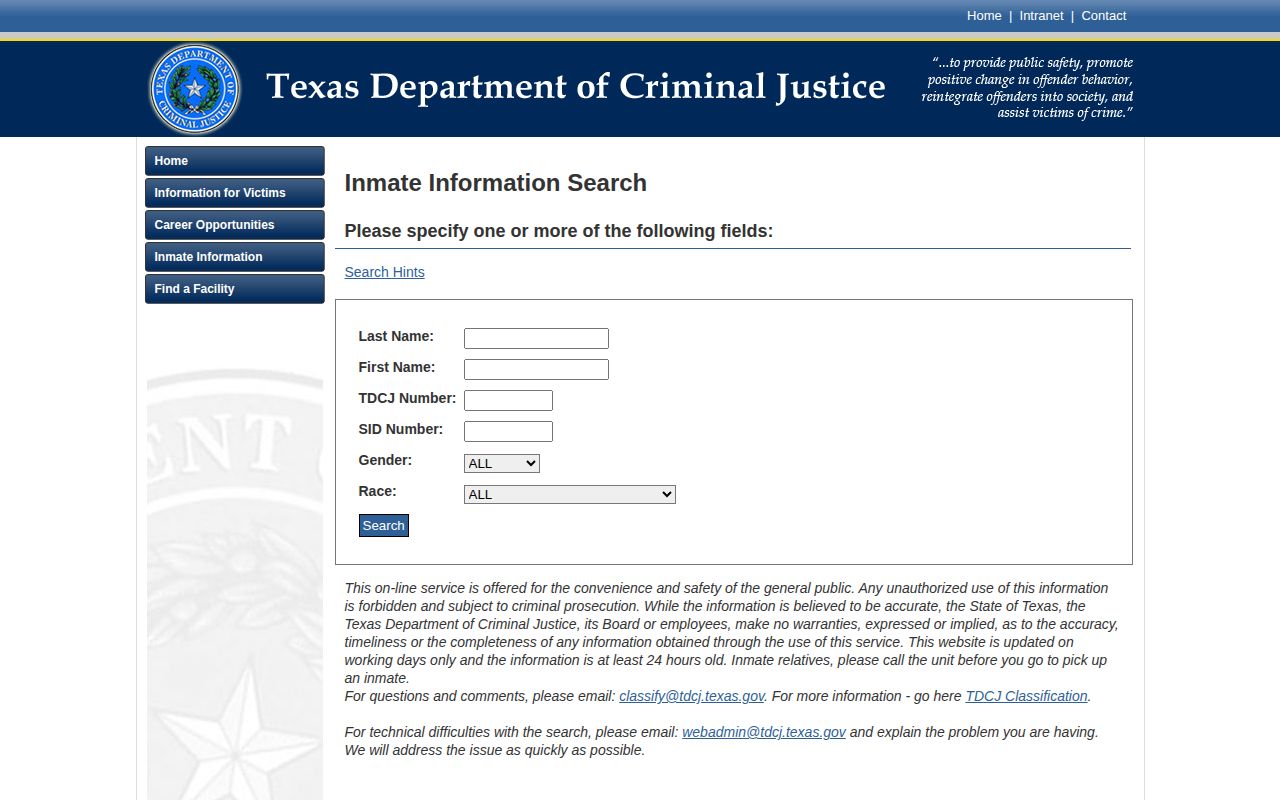
The most important limit appears on the search form itself: online results include only people currently incarcerated in a TDCJ facility. A released or discharged person may no longer appear. Therefore, an empty result cannot show the actual release date, discharge, or parole status.
The official form can be searched with a last name and at least a first initial, or with a TDCJ or State Identification number. Name searches benefit from an exact date of birth when known. Once a match is found, compare all identifiers before relying on the date.
The current TDCJ form documents that limitation:
For an older state event, use the TDCJ Public Information Act portal. Ask for admission, release, discharge, parole or mandatory-supervision dates, release type, and the matching TDCJ-CID number. A narrow request is easier to match than a broad demand for every record.
Texas Good Time Calculation Chain
Texas good-conduct time is governed by Government Code Chapter 498. TDCJ awards classifications of good-conduct time based on conduct, work, and program participation under its rules. The credit can affect eligibility and projected calculations, but the statute says it is not a vested right. That means an inmate does not own an unchangeable release date merely because credit once appeared in a calculation.
Read the calculation as a chain. First identify the sentence and official start or credit dates. Next identify whether the offense and judgment make parole or mandatory supervision available. Then apply the governing good-time classification and any forfeiture. After that, account for the Board's decision, required program, detainers, consecutive sentences, or court changes. Only then does a projected date have useful context.
Government Code Chapter 498 supplies the credit framework. Chapter 508 governs parole and mandatory supervision. Texas does not have one broad rule that all prisoners serve a simple 85 percent. Offense-specific rules must be read from the judgment and applicable law rather than replaced with that shortcut.
Parole Changes DeWitt Release Dates
Parole review adds another decision layer. A favorable Board vote can set a future release date, require a treatment or education program, or include conditions. A denial may set a later review. The Board can reconsider a favorable vote if new facts arise. None of those records alone confirms that the person left prison.
For a person still incarcerated, the TDCJ record's Parole Review Information is the first official view. The Board result line, 844-512-0461, can clarify a status with name, TDCJ-CID number, and date of birth. After a DeWitt County resident is released to state supervision, the Victoria District Parole Office is the assigned regional route. More detail appears in the DeWitt County post-release supervision guide.
Mandatory supervision is not sentence discharge. It is release under supervision based on the statutory framework and the specific case. Discharge means the sentence has ended. Keeping those events separate prevents a projected supervision date from being reported as an unconditional end date.
What Changes DeWitt Release Dates
A projected date can move earlier, later, or disappear from a current result. The cause should be confirmed from an official record rather than inferred from a changed web field.
| Factor | Possible effect | Best source |
|---|---|---|
| Good-time award or loss | Changes TDCJ calculation or eligibility | TDCJ time record and Chapter 498 |
| Parole vote | Approval, denial, later review, or program condition | Board result and TDCJ record |
| Detainer or warrant | May block community release or cause transfer | Holding agency and release entry |
| Court order | May alter sentence, credit, bond, or custody | Signed judgment or order |
| Consecutive sentence | One term follows another | Judgment and TDCJ calculation |
| Processing | Actual exit may not match an estimate to the hour | Jail or prison release record |
A disappearance from the DeWitt current roster could mean community release, transfer, correction, or lag. Likewise, a TDCJ record may stop appearing after release because the public form is current-only. Neither absence supplies the destination.
DeWitt County Court Date Chain
County-level misdemeanors begin with the County Clerk's online index. Felony district cases belong with the District Clerk. Ask for the judgment, sentence, credit, bond order, commitment, revocation order, or other final instrument. The court record explains legal authority. The jail record shows when staff carried it out.
The sheriff's records request form may be emailed to kim.jalufka@dwcotx.org. Give the person's name, date of birth, booking number, date range, and cause number. Ask for the release screen, release date and time, release type, authorizing order, and receiving agency if transferred. No county-specific fee or turnaround was verified, so request an estimate rather than assuming one.
Note: A court dismissal can support release, but another case, warrant, or agency hold may still control custody.
Confirm DeWitt County Actual Release
Use Texas IVSS-Counties as a monitoring tool, not as the final record. The portal may send a release, transfer, booking, court, death, or escape alert from participating interfaces. It also warns that people no longer in custody may not appear and that its data is not an official record.
Preserve any alert wording and time. Then compare it with the DeWitt jail release entry, court order, or TDCJ historical record. If the event was a transfer, name the receiving agency instead of calling it community release. If the person was in federal custody, use the BOP locator or federal record route, not a county or TDCJ date.
The Texas VINELink and IVSS check explains notification steps. The core rule stays simple: projected dates answer what may happen, while official release and discharge records answer what did happen.
DeWitt County Mandatory Supervision Math
Mandatory supervision has its own test under Government Code Chapter 508. It is not automatic early release for every state prisoner. Offense exclusions, Board review, and the person's record can affect whether that route applies. A projected date may reflect the route TDCJ currently calculates, but the field alone does not explain each legal input.
Parole eligibility is also not release. It means the Board may review the case. Review can produce approval, denial, a later review, or a required program. Movement to a program or another unit remains custody. The later TDCJ release record identifies the actual event.
Good-conduct time may be awarded, forfeited, or restored under agency rules. Since Chapter 498 says it is not a vested right, an old projection can change after discipline or classification. Ask TDCJ for the current calculation when official dates conflict instead of selecting the earlier one.
DeWitt County Jail Date Limits
A pretrial person has no sentence calculation, and Citizen Connect has no projected or actual release field. Its last-24-hour and last-seven-day buttons concern admissions. They cannot forecast bond processing or show who left custody.
A county sentence should be traced through the judgment, commitment, and jail credit. “Time served” can explain the legal basis but not the exact exit time. A bond order may authorize release while another warrant or detainer blocks it. The sheriff's release screen must show whether staff completed community release or transferred the person.
No DeWitt rule was found that promises a certain weekend, holiday, or daily processing hour. Contact the jail with the booking and case numbers. Ask which public record confirms completion after the controlling paperwork arrives.
Historical DeWitt Date Requests
After a person leaves TDCJ, the current-only inmate search normally stops helping. A written request can ask for admission, release, discharge, parole, mandatory-supervision dates, and release type. TDCJ accepts requests online, by email, by mail, and by hand through its Public Information Act office.
TDCJ says ordinary copies under 50 pages generally cost ten cents per page plus delivery. Larger work may add personnel and overhead, and an estimate is required above $40. Confidential review may require an Attorney General decision and take about 12 weeks. A request limited to the relevant dates and commitment can reduce cost and delay.
For the DeWitt jail, request the booking sheet and release portion of the jail record. Give the cause number and date range. Ask for the receiving agency if transferred. The court explains why custody could change; the jail or prison record shows when it did.